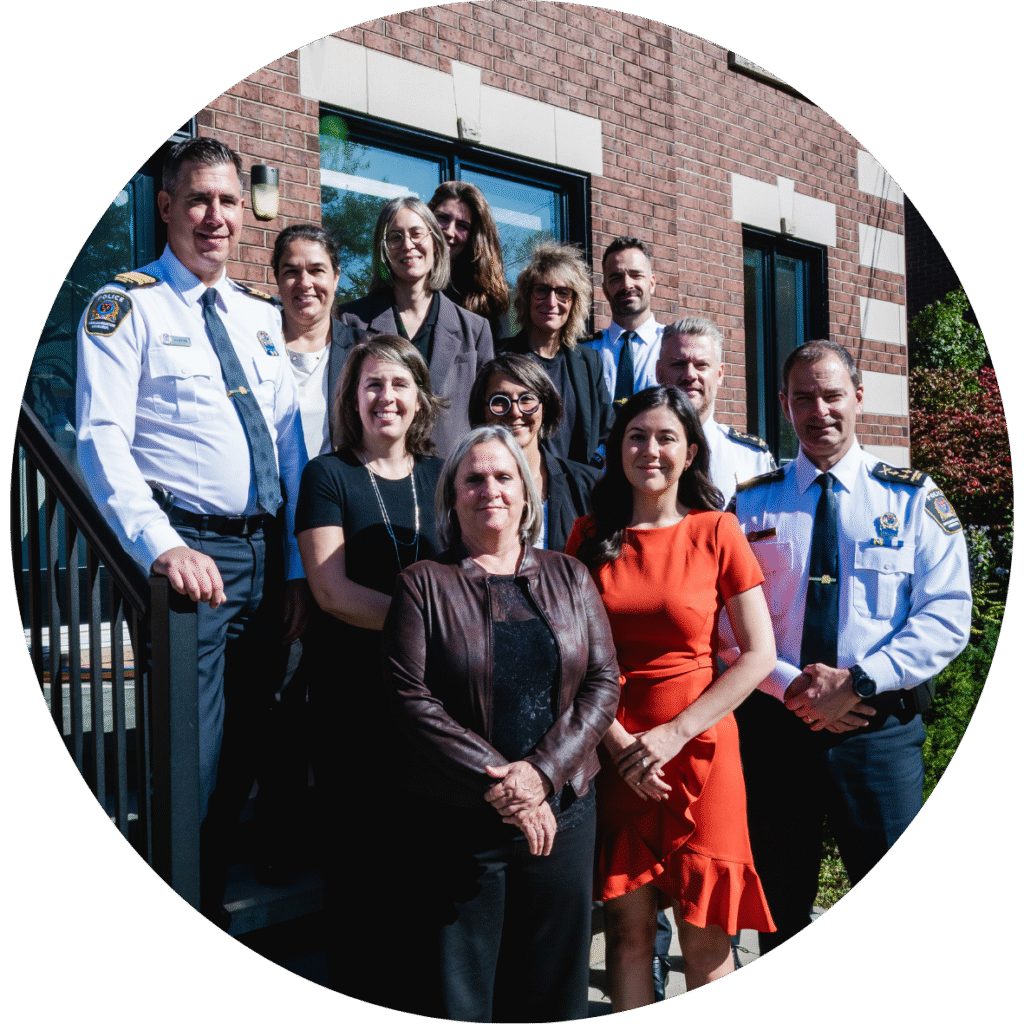
On November 21, 2025, Radio-Canada released a feature on the Centre de services intégrés en violence sexuelle (CIViS), a first-of-its-kind pilot project in Québec created by La Traversée in collaboration with the SPAL and the CAVAC Montérégie. Since 2023, this innovative model has aimed to simplify the path for people affected by sexual violence by bringing together, under one roof, services that are typically scattered across multiple institutions.
An Integrated Model to Reduce Barriers
The idea grew from a simple — and troubling — reality:
The journey of a person who has experienced sexual violence is a maze.
From disclosure, to medical care, to psychological support, to filing a complaint, to navigating the justice system, individuals must knock on many doors, repeat their story multiple times, and relive their trauma again and again.
The Rebâtir la confiance report, published by Québec’s Ministry of Justice in 2021, exposed major system gaps and emphasized the need for a more human and coordinated response.
At La Traversée, a question emerged:
What if, instead of leaving people to navigate this system alone, everything they needed existed in one place?
What if support could be continuous, coordinated, and trauma-informed — from beginning to end?
This is how the CIViS was born. Since 2023, this pilot project — made possible with the support of Québec’s Ministry of Justice — has brought together:
- psychosocial services provided by La Traversée;
- specialized psychotherapy for victims of sexual violence, offered free of charge by La Traversée — a service not accessible for free anywhere else in the community network in Montérégie for adults;
- the expertise of CAVAC;
- the presence of trained SPAL investigators, twice a week, directly on-site.
The objective: simplify the path for victims, reduce barriers, and prevent retraumatization caused by repeating their story.
Reporting Rates Ten Times Higher Than Elsewhere in Québec
Since the CIViS launched:
➡️ 54% of the people supported by La Traversée have chosen to file a police report
➡️ a rate ten times higher than the Québec average (~5%)
➡️ and more than 430 individuals have been supported through this integrated model
These results confirm a crucial reality:
With the right people, fewer barriers, and trauma-informed psychosocial and psychotherapeutic support, more victims feel grounded enough to consider legal or judicial action.
A Person-Centred Approach
The Radio-Canada report highlights what sets the CIViS apart:
- a warm, safe environment adapted to both children and adults;
- the option to give a police statement directly at La Traversée instead of at a police station;
- fluid information-sharing, always based on consent;
- immediate follow-up from the clinical team after an investigative interview;
- an approach designed to prevent retraumatization, particularly by reducing the need to repeat the account of events.
This work also takes place within a broader ecosystem of nearly 40 institutional, community, health-care, and justice partners — all mobilized around the needs of the victim.
A Model with the Potential to Inspire Québec
The Québec government is closely observing the CIViS, seeing it as a promising model for other regions. Over the past two years, La Traversée has been documenting every element of its implementation: the structure, coordination, clinical practices, collaboration protocols, challenges, and results.
More than a physical space, the CIViS represents a new way of thinking and working — one where justice, mental health care, and psychosocial and psychotherapeutic support move forward together, in service of the person affected by sexual violence.
Read the Full Feature
Denis Wong’s Radio-Canada report (in French) — with photos by Denis Wong and illustrations by Mathieu Blanchette — gives voice to victims and to the CIViS teams, illustrating the impact of this initiative for Montérégie and for Québec.